Closures and scope
What a closure is
Section titled “What a closure is”A closure is a function that remembers the variables from the scope where it was created, even after that scope has finished executing.
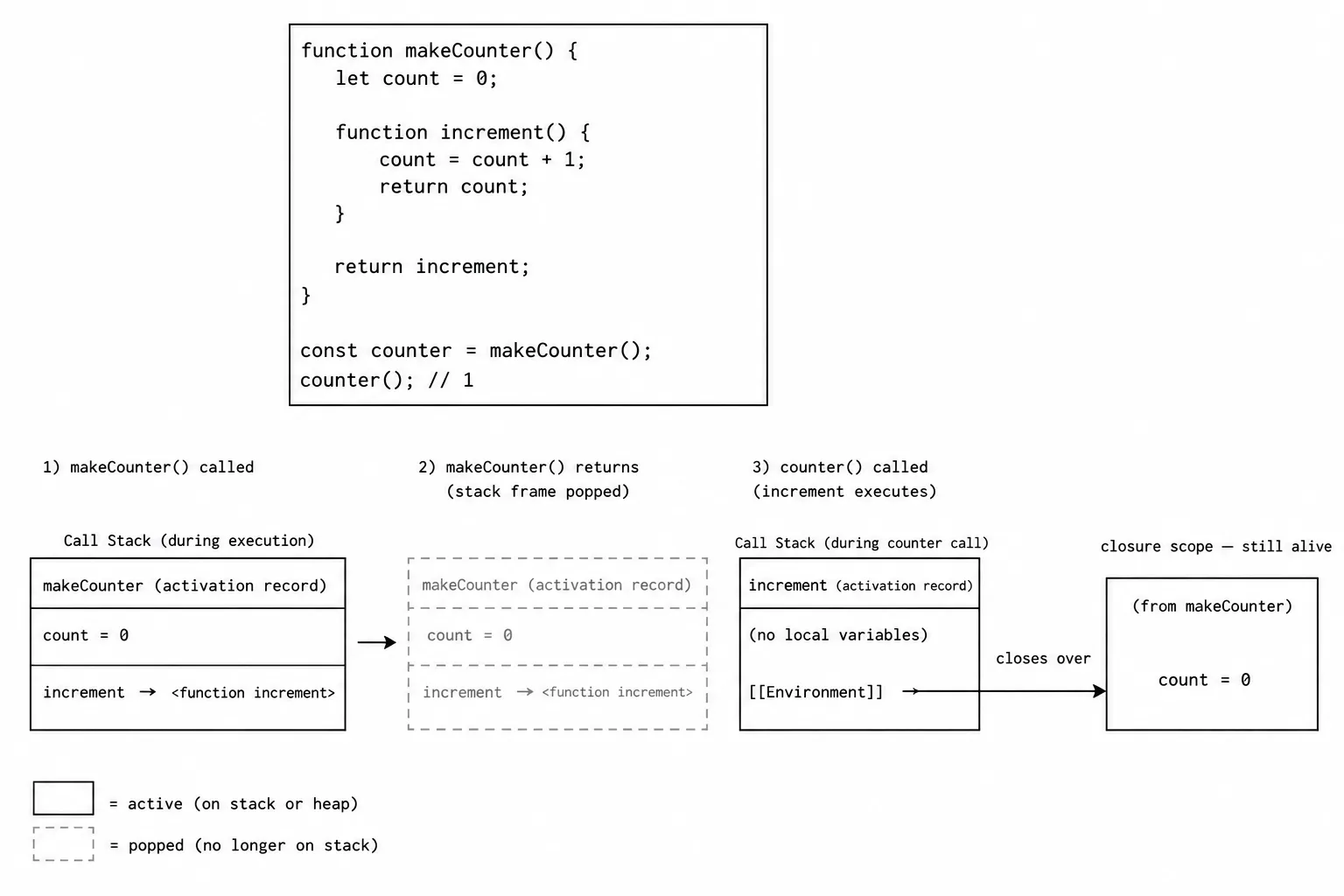
That definition is correct but abstract. Here’s what it means in practice:
function createGreeter(greeting) {  // greeting exists in this scope  return function (name) {    // this inner function can access greeting    // even after createGreeter has returned    return `${greeting}, ${name}!`;  };}
const hello = createGreeter("Hello");const howdy = createGreeter("Howdy");
hello("Alice"); // "Hello, Alice!"howdy("Bob"); // "Howdy, Bob!"
When createGreeter("Hello") runs, it creates a scope containing greeting = "Hello". The returned function keeps a reference to that scope. Even though createGreeter has finished and its stack frame is gone, the scope lives on because the inner function closes over it.
hello and howdy are two separate closures. Each one holds its own scope with its own greeting. They don’t interfere with each other.
Why closures exist
Section titled “Why closures exist”JavaScript has first-class functions (functions are values you can pass around, return from other functions, store in variables). Closures are a natural consequence of this. When you return a function from another function, it needs to carry its context with it. Without closures, the inner function would lose access to the outer scope the moment the outer function returned.
Every language with first-class functions has closures: Python, Ruby, Swift, Go (yes, Go has closures too), Kotlin. It’s not a JavaScript quirk. It’s a fundamental concept in programming languages.
The scope chain
Section titled “The scope chain”When a function accesses a variable, JavaScript walks up the scope chain:
- Check the function’s own local scope
- Check the enclosing function’s scope
- Check the next enclosing scope
- Keep going until the global scope
- If not found anywhere, throw a ReferenceError
Each step up the chain is a closure. The function “closes over” its parent scope. The parent closes over its parent. And so on.
const global = "I'm global";
function outer() {  const outerVar = "I'm outer";
  function middle() {    const middleVar = "I'm middle";
    function inner() {      // inner can access all three:      console.log(global); // walks up 3 levels      console.log(outerVar); // walks up 2 levels      console.log(middleVar); // walks up 1 level    }    inner();  }  middle();}
Try it: watch the scope chain
Section titled “Try it: watch the scope chain”Step through each scenario and see the scope chain build up. Watch how closed-over variables stay alive even after their parent function returns.
Try it: Closure Scope Chain
Step through each scenario and watch the scope chain build up. Closed-over variables stay alive even after their parent function returns.
function makeCounter() {
  let count = 0;
  return function increment() {
    count++;
    return count;
  };
}
const counter = makeCounter();
console.log(counter()); // 1
console.log(counter()); // 2The “Loop trap” scenario is especially important. It’s one of the most common interview questions and the source of real bugs in production code.
The classic loop trap
Section titled “The classic loop trap”This is probably the most asked closure question in JavaScript interviews:
for (var i = 0; i < 3; i++) { setTimeout(() => console.log(i), 100);}// Expected: 0, 1, 2// Actual: 3, 3, 3Why? var is function-scoped, not block-scoped. There’s one i variable shared across all three iterations. The setTimeout callbacks don’t run until after the loop finishes. By then, i is 3. All three callbacks close over the same i.
The fix with let:
for (let i = 0; i < 3; i++) { setTimeout(() => console.log(i), 100);}// Output: 0, 1, 2let creates a new variable for each iteration. Each callback closes over its own i. This is one of the strongest arguments for never using var in modern code.
The pre-ES6 fix (for historical context and interviews):
for (var i = 0; i < 3; i++) { (function (captured) { setTimeout(() => console.log(captured), 100); })(i);}// Output: 0, 1, 2An IIFE (Immediately Invoked Function Expression) creates a new scope for each iteration. captured is a new variable each time, copying the current value of i. This is ugly and nobody writes it anymore, but understanding why it works proves you understand closures.
Real-world closure patterns
Section titled “Real-world closure patterns”Private state (module pattern)
Section titled “Private state (module pattern)”Before ES6 modules and class private fields, closures were the only way to create private state:
function createStore(initial) {  let state = initial; // private, no direct access  const listeners = [];
  return {    getState: () => state,    setState: (next) => {      state = typeof next === "function" ? next(state) : next;      listeners.forEach((fn) => fn(state));    },    subscribe: (fn) => {      listeners.push(fn);      return () => {        const idx = listeners.indexOf(fn);        if (idx > -1) listeners.splice(idx, 1);      };    },  };}
This is basically how Redux works internally. state and listeners are invisible from outside. The only way to interact with them is through the returned methods. The methods close over the shared scope.
Memoization
Section titled “Memoization”function memoize(fn) { const cache = new Map(); // closed over, persists across calls
return function (...args) { const key = JSON.stringify(args); if (cache.has(key)) return cache.get(key);
const result = fn(...args); cache.set(key, result); return result; };}
const expensiveFn = memoize((n) => { console.log("computing..."); return n * n;});
expensiveFn(5); // "computing..." → 25expensiveFn(5); // 25 (no "computing...", cache hit)The cache Map lives in the closure. Each call to the returned function checks the cache first. The cache persists because the closure keeps it alive.
Event handler factories
Section titled “Event handler factories”function createHandler(action, analytics) { return function (event) { analytics.track(action, { target: event.target.id }); // handle the event };}
button.addEventListener("click", createHandler("button_click", analyticsService));The handler closes over action and analytics. You don’t need to pass them every time the handler fires.
Debounce and throttle
Section titled “Debounce and throttle”function debounce(fn, delay) { let timer = null; // closed over
return function (...args) { clearTimeout(timer); timer = setTimeout(() => fn(...args), delay); };}
const search = debounce((query) => { fetch(`/api/search?q=${query}`);}, 300);timer persists between calls because of the closure. Each new call clears the previous timer and sets a new one. The function only fires after delay milliseconds of inactivity.
Memory and closures
Section titled “Memory and closures”Closures keep their scope alive. If a closure holds a reference to a large object, that object can’t be garbage collected as long as the closure exists. This is usually fine, but it can cause memory leaks in long-running applications if closures accumulate.
function processBigData() {  const hugeArray = new Array(1000000).fill("data");
  return function getLength() {    return hugeArray.length;  };}
const getLen = processBigData();// hugeArray (millions of entries) stays in memory because getLen closes over it// Even though getLen only needs .length, the whole array is retained
The fix: don’t close over more than you need.
function processBigData() {  const hugeArray = new Array(1000000).fill("data");  const length = hugeArray.length; // extract what you need
  return function getLength() {    return length; // closes over a number, not the array  };}
Modern JavaScript engines are somewhat smart about this (V8 can sometimes GC variables in a closure that the inner function provably never accesses), but don’t rely on it. Be explicit about what you capture.
Interview angles
Section titled “Interview angles”“What is a closure? Give a real-world use case.” A closure is a function that retains access to variables from the scope where it was defined, even after that scope has exited. Real uses: private state in the module pattern (state is invisible from outside, only accessible through returned methods), memoization (a cache persists across function calls), debounce/throttle (a timer ID persists between invocations).
“Explain the var loop trap.” var is function-scoped, so a loop with var i has one shared i. setTimeout callbacks close over this shared i, and by the time they run, the loop is done and i is at its final value. Fix: use let (block-scoped, creates a new i per iteration) or an IIFE to capture the value.
“Can closures cause memory leaks?” Yes. A closure keeps its entire scope alive. If it closes over a large object it doesn’t need, that object can’t be garbage collected. The fix is to extract only the values you need into local variables before closing over them.